Three formats · building on one another · for small and medium-sized businesses
An Overview of Seminars on VS-NfD.
A series of interconnected sessions for board members, CEOs, advisory board members, and supervisory board members. From a free introductory session to a structured introduction and a practical roadmap. Each session stands on its own but achieves its full impact when combined with the others.
The Perspective
Information Security as a Management Responsibility, Not as Training Based on a Memo
The market offers training at the administrative level. This series takes it one step further: it focuses on deciding whether and how your company will establish its security clearance status to gain access to the defense market. VS-NfD is a strategic decision, not merely an operational task.
“The decision is strategic, not operational. Ignoring VS-NfD is an active decision to turn away from parts of the defense market.”
Sattler 2026, Chapter 1.5.
The Three Formats
Choose where to start
Each card links to the detailed page for the respective seminar.
Step 1 · Free
30-Minute VS-NfD Teaser Webinar
30 minutes · Online
Inspiration for Decision-Makers. Why the ability to maintain confidentiality determines market access, and why acting early provides a competitive advantage.
- Understanding VS-NfD as a barrier to entry
- Self-Assessment of Impact
- No prior knowledge required
Step 2 · One day
One-Day VS-NfD Kick-Off Workshop
1 day · In-person
A Structured Approach. Are we affected? Where do we stand? What should we do right away? At the end, there’s a to-do list for the follow-up workshop.
- Impact Assessment and Status Review
- Initiate initial emergency measures
- List of Assignments for Preparation
Step 3 · two days
Two-Day VS-NfD Setup Workshop
2 days · In-person
In-Depth Analysis: From Assessing the Current Situation to Developing an Actionable Roadmap. Safety organization, accountability, document flow, onboarding procedures, and individual roadmaps.
- Safety Organization and Responsibilities
- The Path to Security Clearance Support
- Personalized Schedule
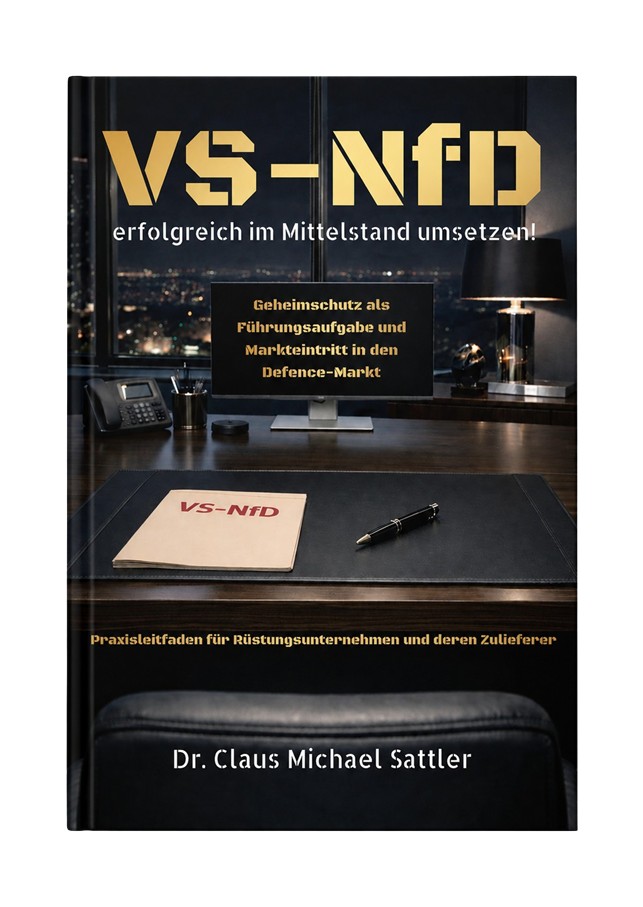
The Book in the Series
The Practical Guide Behind the Seminars
Every volume in this series is built on a well-thought-out foundation. This practical guide takes you from the security policy framework through the legal architecture to secure implementation within your own organization.
Nonfiction · 1st Edition
Successfully Implementing VS-NfD in Small and Medium-Sized Businesses!
Classified Information Protection as a Management Responsibility and Entry into the Defense Market. A Practical Guide for Defense Contractors and Their Suppliers.
In many requests for proposals, the ability to maintain confidentiality is a mandatory requirement for participation. Bidders who fail to demonstrate this capability are excluded as early as the prequalification phase. This book shows how this requirement can be turned into a competitive advantage.
- VS-NfD as a barrier to entry, not as red tape
- The Four Classification Levels and Their Requirements
- The Path to Security Clearance, Step by Step
- Your Customized Roadmap for Market Entry
Dr. Claus Michael Sattler · ISBN 978-3-69250-028-7
The Common Thread
A series that builds on one another
The three steps follow a clear logic: first, recognize the problem; second, determine the location; then, take action. The first step is clarity; the second is action.
Step 1
Recognize
Understanding Impact and Market Access
→
Step 2
Locate
Determine the location and take initial steps
→
Step 3
Trade
Develop a feasible roadmap
In a growing number of procurement processes, the ability to maintain confidentiality is a mandatory requirement for participation. Experienced companies establish this capability even before specific contracts are awarded (Sattler 2026, Ch. 1.4).
Classification
Four levels of classification, a primer
This series comprehensively builds the capabilities required for VS-NfD. Higher classification levels are incorporated so that you can design your architecture to be scalable from the very beginning. Even if you’re currently working exclusively with VS-NfD, you may be faced with higher-classified material in the future.
Focus of the Series
VS-NfD
For official use only. Voluntary commitment to the client; no mandatory security screening.
Classification
VS-CONFIDENTIAL
Intermediate Level. Mandatory enrollment in the security clearance program; basic security clearance (Ü1).
Classification
CONFIDENTIAL
Extended security clearance (Ü2), physical security, and classified records management are required.
Classification
TOP SECRET
Highest level. Advanced security screening with security investigations (Level 3), most stringent requirements.
Classification of the four security clearance levels and security clearances according to Sattler 2026, Chapter 2.4; scalability of the basic architecture according to Sattler 2026, Chapter 2.4.9.
Who is this for?
For Decision-Makers at Mid-Sized Companies
This series is intended for board members, managing directors, advisory board members, supervisory board members, and those responsible for IT, compliance, and procurement. VS-NfD is a leadership issue, not purely an IT task. Responsibility remains with management, even when tasks are delegated (Sattler 2026, Chapter 5.1).